The Cost of Staying Stuck in Guilt And The Freedom of Letting Go

Guilt’s job is simple: signal you’ve fallen short of your own standard. That’s it.
But when guilt lingers, when it becomes a mindset instead of a moment, it turns into self-punishment. It drains confidence, clarity, and identity. It becomes a loop you don’t even realise you’re trapped inside.
This article breaks down why so many people stay stuck in guilt, what it costs you, and how to break the cycle with a simple, practical model I call The Guilt-to-Growth Loop.
Why Guilt Keeps You Stuck
Chronic guilt is subtle. It doesn’t scream. It whispers.
It shows up as hesitation, self-doubt, avoidance, overthinking, or feeling unworthy of the things you want.
Instead of helping you improve, guilt quietly sabotages your ability to move forward. Here’s how it plays out:
You burn mental energy replaying the past instead of building the future.
You decline opportunities because you “don’t deserve them yet.”
You hold yourself back to make others comfortable.
You apologise repeatedly without changing behaviour.
You become reactive or defensive in relationships.
You lead from fear rather than conviction.
And eventually:
Your life becomes an emotional rerun, the same mistake acted out in new scenes, with new characters.
That’s the real cost of guilt. Not the mistake itself but the self-punishment that follows it.
Where Most People Go Wrong With Guilt
Most people are never taught the difference between healthy guilt and chronic guilt.
So they confuse guilt with goodness. They confuse rumination with responsibility. They confuse shame with growth.
Here are the six most common misconceptions:
Believing guilt makes you a better person
Thinking holding onto guilt proves accountability
Using guilt as motivation
Letting guilt shape your self-worth
Apologising without changing your behaviour
Mistaking shame for personal development
These patterns don’t elevate you. They quietly erode who you believe you can become.
The Truth: Guilt is a signal, not a sentence.
Healthy guilt gives you information. Unhealthy guilt takes your identity.
The goal isn’t to eliminate guilt, it’s to use it properly. To let guilt alert you, not attach to you.
And that distinction is where the Guilt-to-Growth Loop begins.
The Guilt-to-Growth Loop
A Simple Model for Turning Guilt Into Forward Motion
This framework exists because every person I’ve coached has experienced the same emotional pattern, including me.
The loop has three phases:
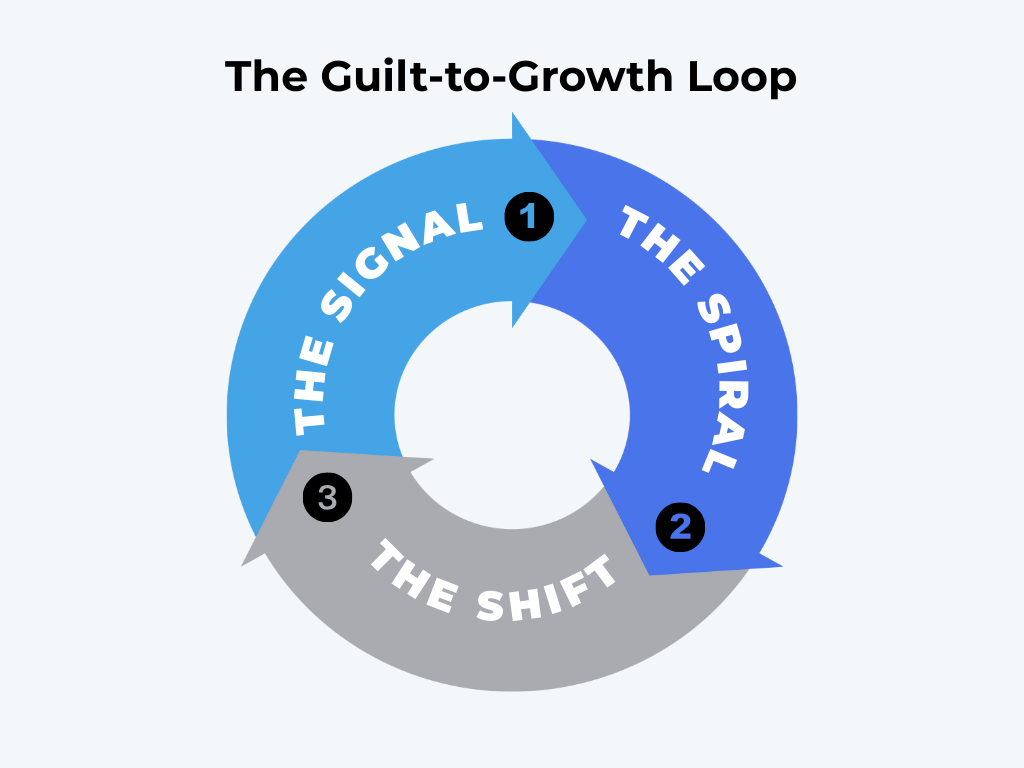
1. The Signal
This is the initial discomfort. A pinch in your chest. A moment where your actions don’t align with your values.
This phase is healthy. It's important. It’s your internal compass saying: "You’re better than that. Pay attention."
2. The Spiral
This is where people get trapped.
Instead of learning from guilt, you begin to loop in it. You replay conversations. You analyse tone. You judge yourself harshly. You stall instead of repair. You freeze instead of act.
In this phase, guilt stops being a message and becomes an identity.
3. The Shift
This is the turning point, the moment guilt becomes growth.
The Shift is where you:
Take responsibility
Repair what you can
Change your behaviour
And let the rest go
This is the phase most people never reach. Not because they can’t but because they were never taught it’s an option.
When you master the Shift, guilt becomes a tool instead of a burden.
The Research That Confirms This
A 2007 peer-reviewed paper in Personality and Social Psychology Review by Tangney, Stuewig, and Mashek found something powerful:
Guilt-prone people tend to take responsibility and repair, which is healthy.
But chronic guilt leads to rumination, anxiety, depression, and avoidance,which is destructive.
In other words: Guilt helps when it leads to action. Guilt harms when it becomes an obsession.
This is the psychological foundation behind the Guilt-to-Growth Loop.
Why Guilt Turns Into a Loop
Guilt is the mind’s attempt to regain control after you fall short of your own standards. But when you stay in guilt, you don’t regain control, you lose it.
Instead of learning, you relive. Instead of growing, you grind yourself down.
The way out is not more guilt. It’s responsibility, repair, and release.
Three Ways to Break the Loop Today
1. Identify where guilt keeps you frozen
Look for areas where you shrink, hesitate, or self-sabotage.
2. Ask what you’re actually protecting
Most guilt protects you from discomfort, not from truth.
3. Replace guilt with one meaningful action
Guilt dissolves when integrity returns.
A conversation. A decision. A boundary. A behaviour change. A repair.
Growth doesn’t require perfection, it requires movement.
A Personal Story: When Guilt Held Me Back
When my career started accelerating, I felt guilty watching friends who began at the same time struggle.
We were on the same path. We had similar dreams. But we weren’t making the same progress.
I felt responsible for their feelings. I felt guilty for outgrowing them. And I held back my own potential because I didn’t want anyone to feel left behind.
Then it hit me:
Shrinking myself didn’t help them. It only stalled me.
People don’t rise because you dim your light. They rise because you show what’s possible.
Letting go of that guilt wasn’t selfish. It was necessary.
It allowed me to grow and eventually help others grow too.
Final Truth
Feeling guilty is the start of integrity. Staying guilty is the end of it.
Your life begins again the moment guilt ends.
Want to know exactly where guilt, stress, or self-doubt is holding you back?
Take the Life Performance Scorecard a 3-minute assessment that reveals:
Where you're stuck
and your personalised next steps